

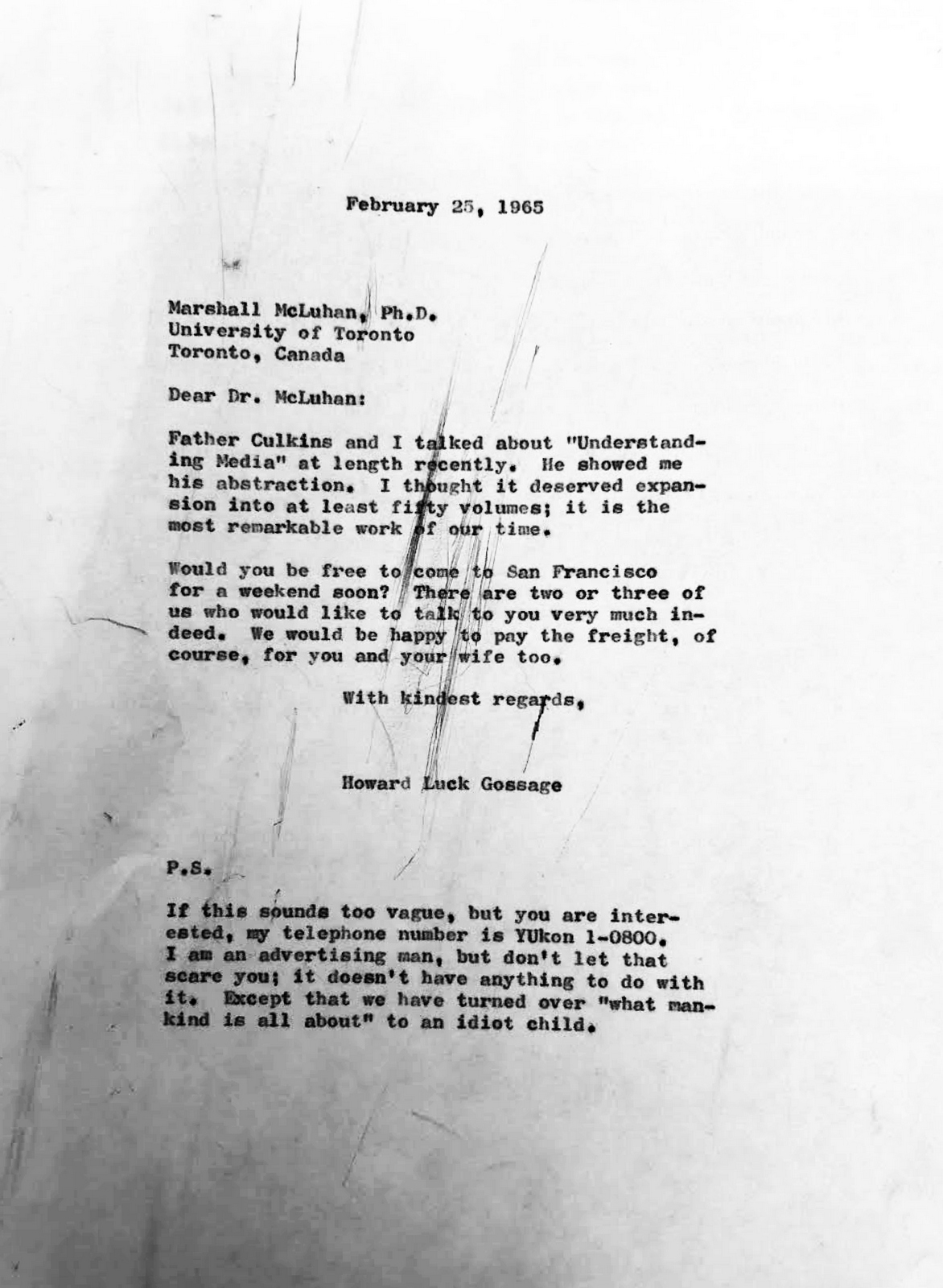
THE MAKING OF A CELEBRITY - By Steve Harrison.We've just left Gossage exhausted by what he called that “race without a finish”, advertising. After ten years’ hard slog, he was desperate to surrender his lane to someone else.But what next?Well, it was around the mid 'sixties that psychologist Abraham Maslow observed,“To the man with a hammer, everything looks like a nail.” As far as Gossage was concerned, this “Law of the Instrument” hit the ad industry on the head. It seemed wrong to him that every time a client had a problem, their agency proposed an ad campaign.Adman Gossage found a perfect foil in Gerald Feigen who was, in no particular order, a painter, television commentator, ventriloquist, lecturer and the country’s leading proctologist.According to journalist Warren Hinckle, “Traffic slowed down when they crossed the street, heads turned when they walked into a room. Feigen looked like the prototype of the mad professor while Gossage chains smoked Gauloises like a Pittsburgh chimney.”.By early 1965 this odd couple had set up in business as Generalists, Inc.INSERT BUSINESS WEEK LETTERS FROM GOSSAGE AND FEIGEN EXPLAINING WHAT THEY DID.As long as the problem was intriguing enough, he and Gerry Feigen were willing to take any client. For example, at one point they were advising both the Berkeley University’s revolutionary Free Speech Movement and the Chancellor of the University - although as Gossage told his friend Barrows Mussey, “the kids nor the University know of the other”.Their aim was to solve clients’ problems with ideas before or beyond advertising. But not just that. They took on bigger societal issues. And, if they couldn’t find the answers themselves, they’d seek out visionaries who could offer their own theories on the peculiarities and pathologies of medern life.As Gossage had it: “we are guru discoverers”.The first “guru” was a Jesuit priest, Father John Culkin who was pioneering what we now know as Media Studies at Fordham University.As you’ll see from this letter, it was Father Culkin who turned Gossage on to another leader in that field.
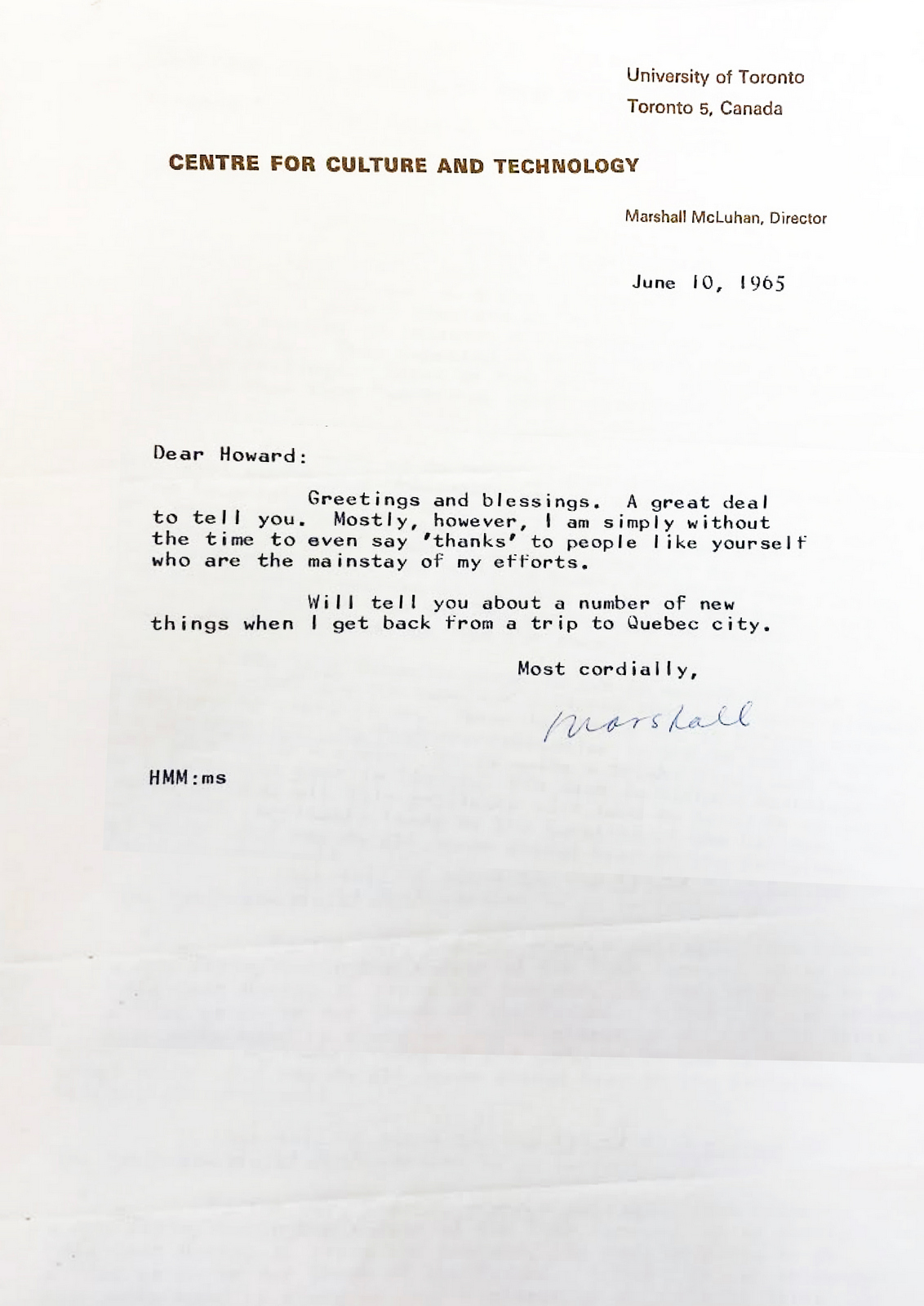
When they spoke, Gossage asked McLuhan if he wanted to be famous. Apparently, McLuhan answered “yes”, but he was too busy grading end of term papers.Gossage's idea of fame would have aligned pretty much with Jeremy Bullmore's definition on page x: being known by people way beyond your target market.Conversely, if you'd asked McLuhan to identify the target for his books and theories he'd probably have said fellow academics. Or even students. After all, Understanding Media had its origins in the syllabus he'd written for an eleventh grade high school class.At that stage, McLuhan was known to his peers. but not, according to Gossage, greatly respected. As he put it: “At a high level educational conference on mass media at Washington, reference to his theories were accorded that profound non-response usually reserved for stomach rumblings in chapel”.For Gossage and Feigen those educational conferences were a thing of the past. McLuhan's long time collaborator, Edmund Carpenter recalls in "That Not-So-Silent Sea" the plan was "to convert McLuhan into an internationally recognized media guru, then peddle him as a business consultant, fees to be established."The ad platform technique - without the adWe'll pause there on the reference to "peddle". Because it harks back to Paul Feldwick and the premise of his book, Why Does the Pedlar Sing. As we saw on page x, the peddlar, the hawker, the huckster sings because he's trying to entertain his audience so he can then make a sale.Feldwick says such showmanship found its apogee in the 19th century impressario P.T. Barnum. And to portray Barnum's ballyhoo at its most ambitious he cites a campaign very similar to that planned 115 years later by that other master of media manipulation, Howard Gossage.In Barnum's case, it was the launch of "The Swedish Nightingale", Jenny Lind. According to Feldwick, "Barnum waged a sustained campaign of creating ‘news’ aboutJenny Lind which the newspapers could not resist amplifying."By May 1965 the Generalists were embarked on their own "sustained campaign of creating news." With $6,000 of their own money, they took their 53 year old protege to the East Coast where, in restaurants affordable only to those on corporate welfare, he was introduced to the nation's leading media owners, newspaper reporters, TV journalists and admen.One of the media men was journalistTom (Bonfire of the Vanities) Wolfe who was covering McLuhan’s tour for a New YorkHerald Tribune. "Looking back, I can see that Gossage, but not McLuhan, knew what was going to happen to McLuhan over the next six months. Namely, that this 53 year-old Canadian English teacher, grey as a park pigeon, would suddenly become an international celebrity and the most famous man his country ever produced."McLuhan certainly sounded a little overwhelmed in this June 1965 letter to Gossage:
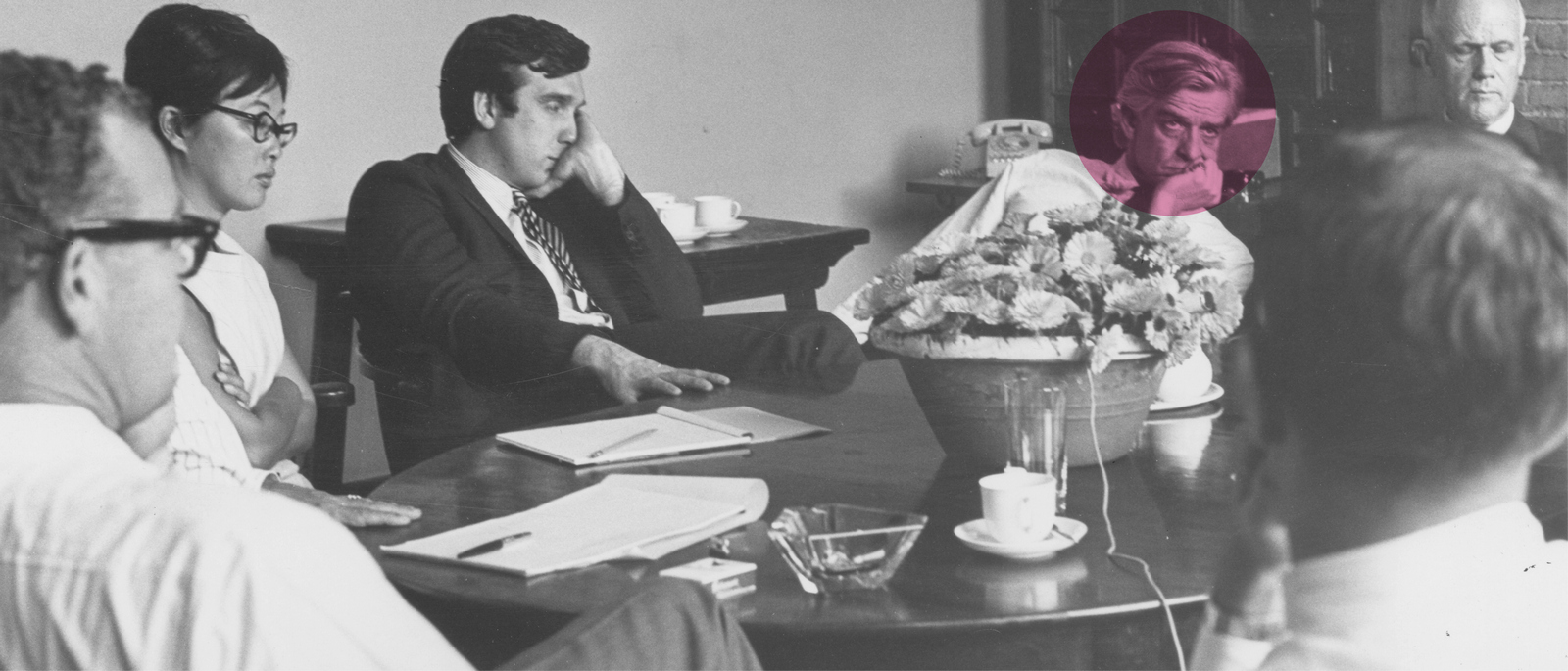
McLuhan was at the centre of Gossage’s publicity generating “ad platform technique”. But this time the adman hadn’t even bothered with the “ad”. Instead, in August 1965, he amplified the message by orchestrating a series of seminars at his agency
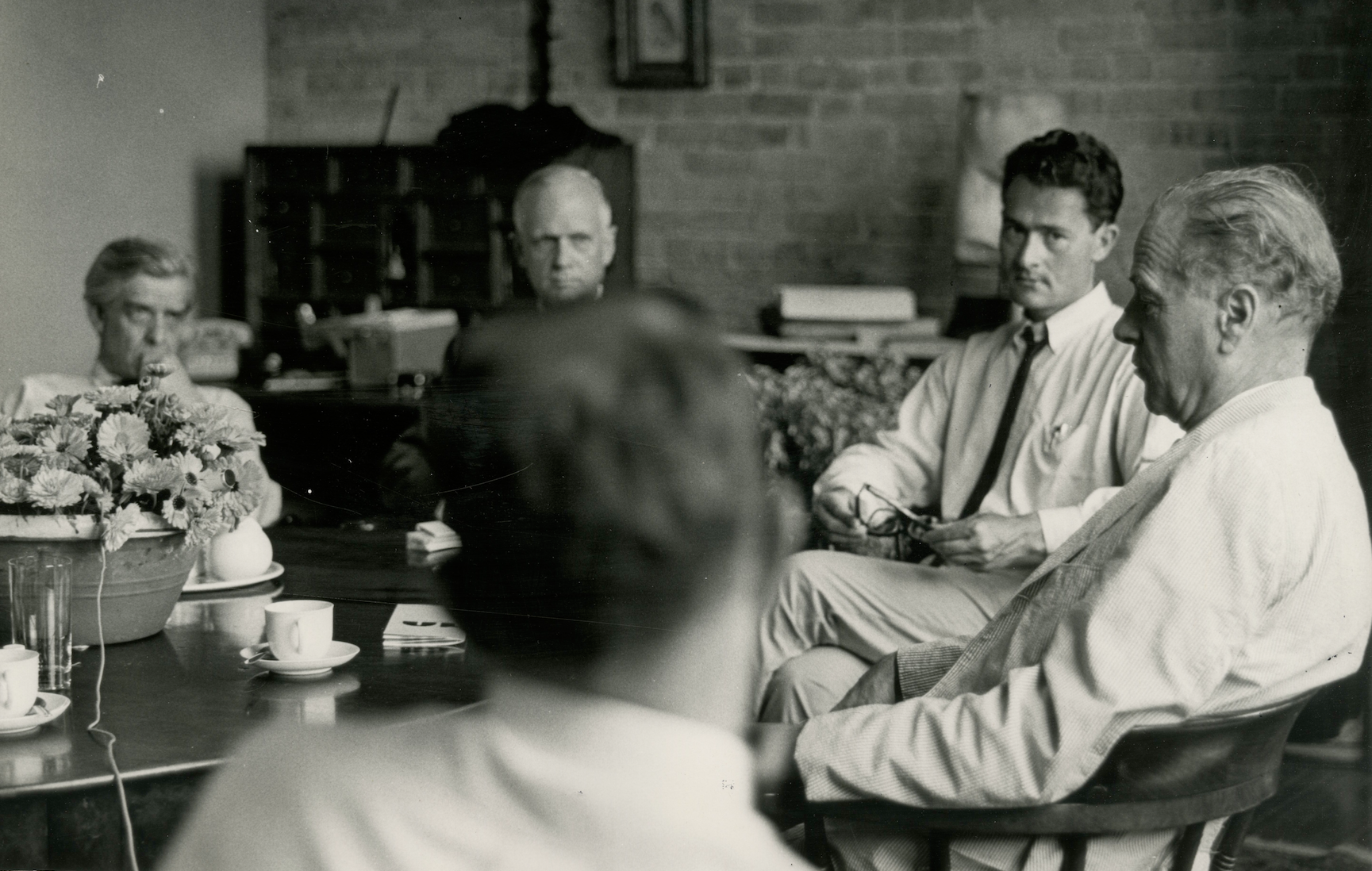
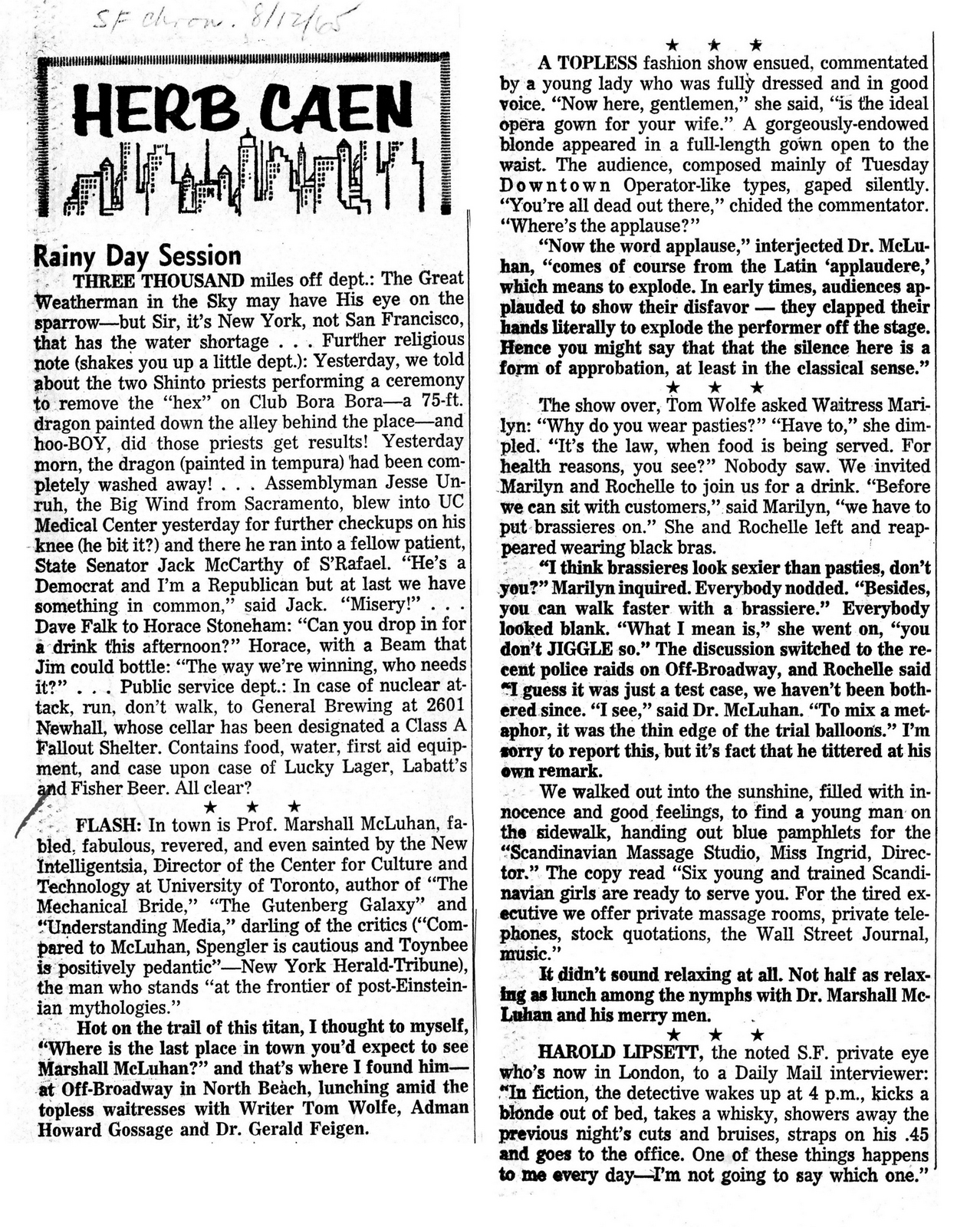
That's Gossage far left and McLuhan far right. It looks very intense, and everyone seemed more relaxed once they'd decanted to Klamath, Walter Landor's luxurious ferryboat where this photograph was taken.From left to right are (top) are President of Freeman, Mander and Gossage, Alice Lowe;San Francisco Chronicle Columnist, Herb Caen; San Francisco city developer, Justin Herman; Generalist, Gerry Feigen; Marshall McLuhan and wife, Corinne McLuhanFront: Industrial designer and branding guru, Walter Landor; Howard Gossage; and pioneer of the New Journalism school and, later, novelist Tom Wolfe.Gossage, Caen and Wolfe then took the cloistered academic for lunch - at a topless restaurant on Broadway. Here's Herb Caen’s column of the following day:
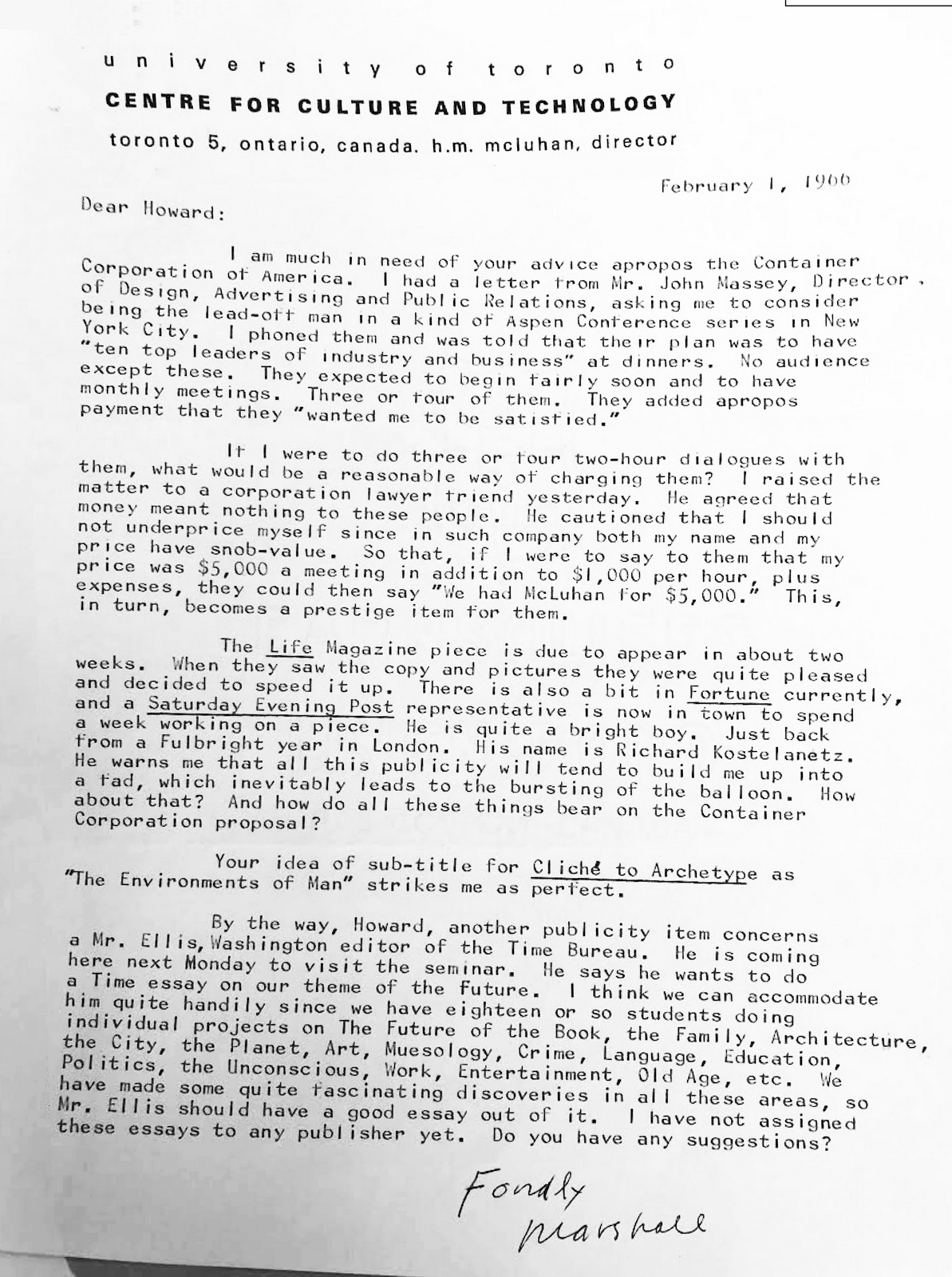
Tom Wolfe returned to New York to file his copy for “What if he’s right?” - the NEW YORK magazine article that supercharged McLuhan’s media career.McLuhanacy gathered pace and, in 1966, he was the focus of 120 major features in magazines across the US, Canada and the UK. Newsweek splashed him on its cover, and Life magazine announced the coming of “the oracle of the electric age”. All seemed convinced that, at last, North America had produced a thinker, with a unified theory of everything, who could rival the best of Europe's intellectual heavyweights - past and present.But no thinker had ever benefited from the kind of marketing and electronic media coverage that jet propelled McLuhan to fame. He had become, to quote his biographer Douglas Coupland, “A superstar …. At a certain point in the mid-1960s he stopped being merely a brainy academic from Toronto. He became a massive brand, as famous and synthetic and misunderstood and misquoted as fellow 1960s media construct and artist Andy Warhol.... He was everywhere. He was hip and cool and groovy and far out. He was a fraud, a monster, a genius, and a hoax. Young people loved him. Talk shows were incomplete without him.”But even then, he was reliant upon Gossage. Here he is asking advice on how to handle his corporate clients.
Gossage was also on hand to explain his theories.Alice Lowe felt that: “McLuhan was pretty hard to understand because he goes round and round and round. Howard would say ‘you mean...’ and turn it into something an ordinary person could understand. On the wall at the Firehouse there was a lot of graffiti and I think it was Marshall McLuhan that had written ‘the Medium is the Message’. Some disrespectful person had crossed out the ‘M’ and put a ‘T’.”INSERT THE GRAFITTI The Tedium is the MessageTo clarify things further, Gossage wrote a feature article in Ramparts magazine titled “Understanding Marshall McLuhan”. In a preface to the article, the Ramparts editor Warren Hinckle noted that McLuhan “once remarked that Gossage understood McLuhan better than McLuhan understood McLuhan.”INSERT GOSSAGE’S ARTICLEHinckle was very close to Gossage and, as such, an eye witness to McLuhan’s reliance upon the adman.He described their relationship: "Gossage was always kind of translating for the potty prophet. 'What Marshall means by all this is that...' But a lot was added in the translation and McLuhan would look at Gossage like the Mad Hatter peering over the tea cup and say, in a voice that was part confused innocence, part modest genius, 'Gee, Howard, that's exactly what I meant when I wasn't saying it'.”Whatever it was that McLuhan wasn’t saying, the public lapped it up.At the beginnning of this chapter, we noted that being famous means being talked about by people way beyond your target audience. Gossage had achieved that for McLuhan. By the late ’sixties he had become a celebrity. Daniel J Boorstin, who brought us The Pseudo Event in his book "The Image", also gave us a defintion for this creature of modern media: the celebrity was simply someone who was “well known for being well known.” Famous, yes, but not for anything that the mass audience might use, enjoy or understand. But simply because by good luck, a gift for self-promotion, a marketable asset or a sizeable advertising budget they've captured public's attention.While it's true that McLuhan's The Medium is the Massage sold nearly a million copies, it's probably a classic example of the book everybody bought but not many read.Having said that, there was one group of people who understood his insights, and acted on them: the hippies and members of the counterculture who, at that time, were gravitating toward San Francisco.The counterculture’s intellectual heavyweights set about making McLuhan’s prophecies real. And they did so not by projecting them onto TV screens, as McLuhan predicted, but by plugging them into a network of ‘personal computers’As the electro-hippies experimented with ever more effective ways of creating such a network, their old mentor, McLuhan suffered the inevitable fate of the celebrity and faded from public view.So much so that today he is primarily known only for such aphorisms as “The global village” and “The medium is the message”. However, those who know their digital history will tell you, it was McLuhan who inspired the hobbyists and hackers who became the internet’s most influential innovators.Indeed, they paid their debt to him when, in 1993, Kevin Kelly, launched Wired magazine and immediately pronounced McLuhan the “Patron Saint of the Digital Age”.INSERT WIRED MAGAZINE FRONT COVERINSERT MAGAZINE ARTICLEIf McLuhan was ahead of his time then, as we’ve seen throughout this book, so was the man who made him famous.As Symbolism.org’s “The Medium of the Messenger” had it: “McLuhan may have been a major precursor of cyberculture. But the promotion of him was also a major precursor of contemporary celebrity manufacturing. Perhaps one of the original textbook cases. Gossage’s mixture of marketing and news, design and promotion, PR and planted "newsworthy" journalism – almost Joycean in effect with its barrage of various media – in many ways previewed postmodern marketing and public relations.”It seems that everything from that Mississippi canoe trip onwards came together in the launch of McLuhan via that "mixture of marketing and news, design and promotion, PR and planted "newsworthy" journalism".And, no doubt to Gossage's satisfaction, it had nothing to do with conventional advertising.He and Feigen were on a roll. The success of the McLuhan launch proved they were much more than a couple of eccentrics on the marketing world's margins. They'd created their own niche industry, and it wasn't long before they'd found their next guru.Here the “genius” was Leopold Kohr who argued for the break-up of nations and reintroduction of city states. And the publicity generating pseudo event was a very real revolution in the Caribbean.INSERT LETTER FROM GOSSAGE TO KOHRLike McLuhan, Kohr was promoted via a series of seminars at the Firehouse which, Gossage felt, “were sure to attract the attention of the press, TV etc”But this time there was no Tom Wolfe to focus media attention, and Kohr went off to teach Economics and Public Administration at the University of Puerto Rico.Then, a couple of months later in Spring 1967, Kohr contacted Gossage to tell him the people of the Caribbean island of Anguilla had declared independence from the island federation of which they’d been a member. The British Government frowned upon the break-up of one of its Commonwealth dependencies and started to put pressure upon the Anguillans to get back in line. The rebels needed help!As Gossage recalled: “Kohr called me from San Juan to tell me excitedly that he had found a ‘marvellous island’ upon which to experiment his carefully developed theories of smallness."Nation-building is an expensive business and to achieve it Gossage, Feigen and other like-minded adventurers set up a line of credit for $80,000 dollars.Much of it was invested in thousands of silver coins which were shipped to Anguilla to be used as the new currency. The heads of the breakaway government were then flown to New York to speak at the United Nations. From New York they were taken to a celebration of independence at the St Francis Hotel in San Francisco for which Alice Lowe was delegated to come up with the catering and Marget Larsen was tasked with running up the new nation’s flag.It wasn’t, however, going to be that simple. With a British frigate preparing to land 40 policeman and the rebels’ resolve wavering, Gossage fell back on his core competence to knock out what he later said was “the best ad I ever wrote”.INSERT: IS IT SILLY.Readers of the New York Times and International Herald Tribune were promised an honorary Anguillan Passport for every $100 they donated. The money rolled in and, with the media spotlight on the island, the threat of a bit of latter day British gunboat diplomacy faded.But so, too, did the ideals that had originally inspired the Anguillan rebels. Not only did they start to seek outside investment, they also disowned the New York Times fundraising advertisement, which left Gossage and his partners open to accusations of fraud.Things got worse when those who’d sent their $100 didn’t receive their passports.INSERT LETTER FROM IRATE DONOR.Gossage went to Anguilla and in his words; “Blew up. I said that we had financed the whole damned enterprise; we brought their missions to the United States; we paid the bills for their Ambassador-at-Large and sent a man to help him out. And what have they done? Discredited us. After my speech they handed me a bar check to sign, for $32.“Then one of the men asked me what I was going to do next. So I told him, ‘I’m going to get a great big boat and tow your fucking island out to sea and watch it sink’.”Obvliously he wasn't happy with the outcome - especially when he was saddled with a personal loss of $11,000. But he persisted with Kohr and was, in retrospect, pleased with the impact he'd had with the New York Times ad.As he said: “I don’t think we realise what a powerful weapon we have in advertising and how much you can do with very little money. This ad in the New York Times and in the Herald Tribune in Europe together cost $10,000. Well, to do that much with just one ad, and really to do it that inexpensively, is something."Yes, it was "something". But really the adman didn't need Marshall McLuhan to tell him that print is a hot medium and conducive to involvement and interaction. That was Gossage's schtik. And he, better than anyone, knew how to use it to maximum effect.With one ad, he'd hoiked the spotlight onto Anguilla, making its half-hearted fight for freedom momentarily famous. In so doing he had, of course, also enjoyed that spotlight's halo effect and burnished his own image and celebrity.Which brings us, finally, to perhaps the greatest of all his media events and showbiz sensations.GOSSAGE AND THE PERSONAL BRAND


Lorem ipsum dolor sit amet, consectetur adipiscing elit. Suspendisse varius enim in eros elementum tristique. Duis cursus, mi quis viverra ornare, eros dolor interdum nulla, ut commodo diam libero vitae erat. Aenean faucibus nibh et justo cursus id rutrum lorem imperdiet. Nunc ut sem vitae risus tristique posuere. uis cursus, mi quis viverra ornare, eros dolor interdum nulla, ut commodo diam libero vitae erat. Aenean faucibus nibh et justo cursus id rutrum lorem imperdiet. Nunc ut sem vitae risus tristique posuere.
Delete